Checkout vs. Settlement Currency: A Merchant's Conversion Guide
Learn how checkout and settlement currencies differ, where conversion costs arise, and how to compare a multi-currency gateway against your actual sales needs.
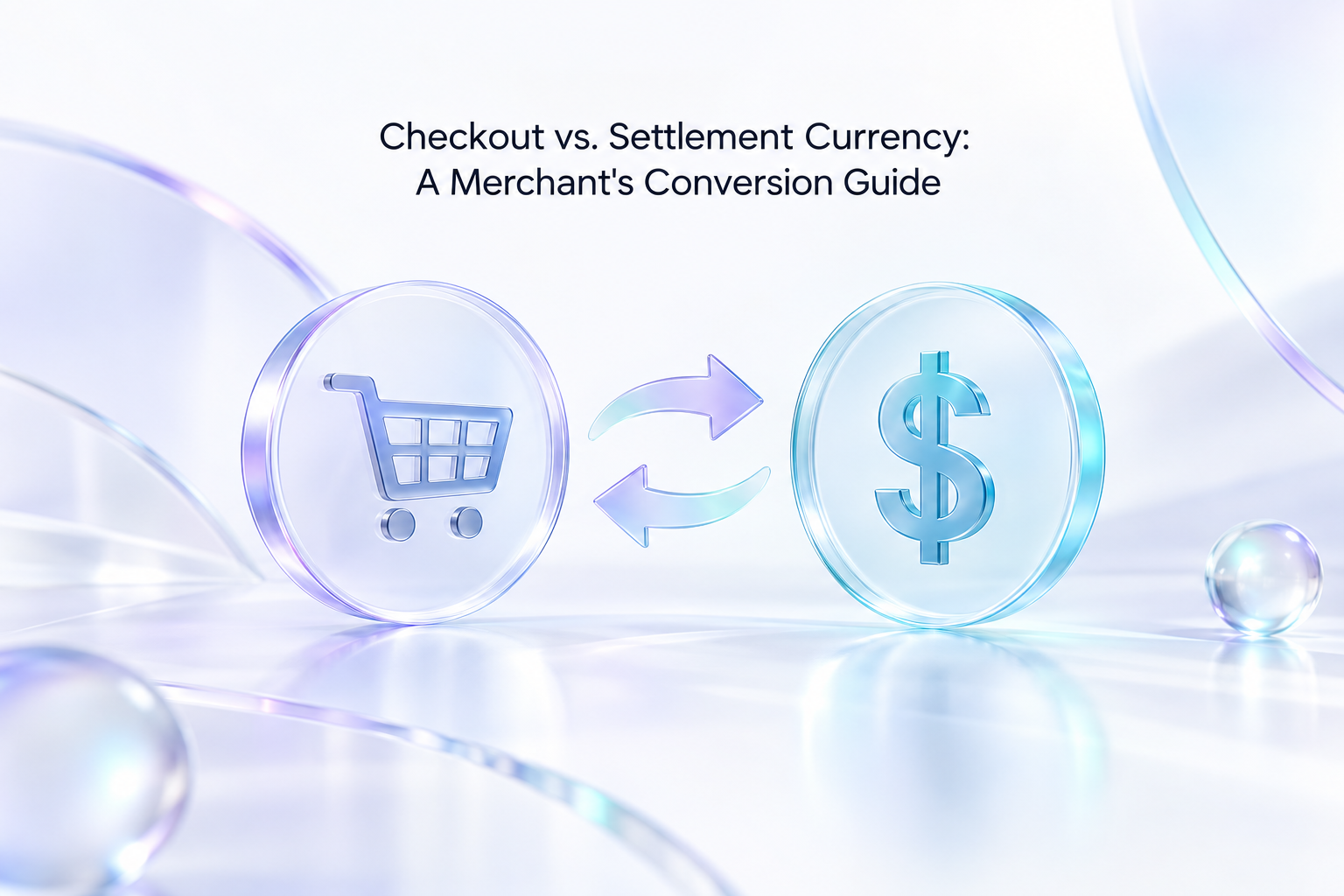
International payment pricing can look straightforward: show a price in the customer's currency, accept the payment, and receive the proceeds. In practice, the currency shown on a product page, the currency charged at checkout, and the currency received by the merchant may not be the same.
Understanding those differences helps you ask better questions before choosing a gateway. It also prevents a common mistake: treating support for multiple currencies as a guarantee that money will move without conversion. This guide explains how to map the currency route, compare costs, and test whether a proposed configuration fits your business.
1. Separate the Three Currency Questions
What currency does the storefront display?
The display currency is the currency a shopper sees while browsing. A storefront may estimate a local price using an exchange rate without actually processing payments in that currency. For example, a product page could show a local-currency estimate while the checkout ultimately charges in the merchant's default currency.
That distinction matters because customers should understand the final currency and amount before authorizing payment. A familiar symbol on a product page is not proof of local-currency payment acceptance.
What currency is the customer charged in?
The presentment or transaction currency is the currency submitted for the payment. This is the key currency to confirm when assessing whether a gateway can accept the payment you intend to offer.
If that currency differs from the customer's card-account currency, the card issuer or another party may apply conversion or cross-border charges under its own terms. A merchant cannot assume that its gateway pricing describes every fee a customer might pay.
What currency does the merchant receive?
The settlement currency is the currency in which the processor settles the transaction proceeds to the merchant under the relevant arrangement. The eventual bank deposit can involve another conversion if the receiving account cannot accept that currency as sent.
Ask about the complete route. Support for charging a currency does not necessarily imply support for settling that currency unchanged.
2. Map the Currency Route Before Comparing Offers
Start with one typical order from each important customer market. Write down the displayed currency, charged currency, gateway settlement currency, and receiving-account currency. Mark every point where a conversion could happen.
A simple requirements table can make gaps visible:
| Question | Information to record | | --- | --- | | Customer-facing price | Currency displayed before checkout | | Authorized payment | Exact currency submitted for the charge | | Processor settlement | Currency available under the proposed configuration | | Receiving account | Currency the destination account can accept | | Conversion responsibility | Which party converts at each stage | | Applicable costs | Rate basis, markup, fixed fees, and other charges |
Watch for an unnecessary second conversion
Imagine a customer pays in euros, the processor converts the proceeds into dollars, and the receiving institution converts them back into euros. Each conversion may carry a cost. The original payment and final bank balance can use the same currency while the route between them still includes two conversions.
This does not mean every gateway offers a way to avoid that route. It means the route should be visible before you decide whether the arrangement is acceptable.
Consider the currency of your expenses
Your preferred settlement currency should reflect more than the location of your customers. If your suppliers, payroll, and tax obligations are largely in one currency, receiving another may simply move the conversion decision downstream.
The useful question is not always, “Can I avoid conversion?” It may be, “Where does conversion make the most operational and financial sense?”
3. Compare Effective Costs, Not Just Advertised Rates
A currency conversion offer can involve a reference exchange rate, a markup on that rate, a separate percentage fee, or some combination. Payment processing charges may also differ for international transactions. Ask how each applicable charge is calculated and whether the quoted rate includes any markup.
Use a clearly labeled hypothetical calculation
Suppose a customer pays EUR 100. For illustration only, assume a benchmark rate of USD 1.10 per euro. Before fees, that amount would equal USD 110.
Now assume the applied conversion rate is USD 1.078 per euro, which is 2% below that benchmark. The converted amount would be USD 107.80. If a separate USD 3 processing charge were then deducted, the remaining amount would be USD 104.80.
Under these simplified assumptions, the difference from the benchmark value is USD 5.20. This is not a provider quote, and real fee ordering may differ. The example shows why a processing percentage alone cannot describe the entire cost.
Keep the comparison consistent
When comparing offers, use the same transaction amount, currency pair, payment method, and exchange-rate timestamp or benchmark convention. Otherwise, normal rate movement can make one offer appear cheaper even when its pricing structure is not.
Request both the formula and a worked example. If fees are deducted before conversion, charged separately, or subject to minimum amounts, include that in the comparison. Do not assume a sample calculation applies to every currency pair.
4. Choose a Customer Pricing Approach Deliberately
Currency support creates pricing choices; it does not choose a pricing policy for you. Two common approaches are fixed local prices and automatically converted prices.
Fixed local-currency prices
A fixed local price gives shoppers a stable amount in their market. It can simplify customer communication and produce cleaner-looking prices. However, the value received in the merchant's operating currency can change as exchange rates move.
Review local prices on a schedule appropriate to your margins and sales volume. Account for taxes, applicable fees, and conversion costs rather than translating the base price in isolation.
Automatically converted prices
Automatically converted prices can track exchange-rate changes more closely, depending on how the storefront or payment configuration works. They may also create changing amounts between customer visits or less familiar price endings.
Confirm when the rate is set: while browsing, when checkout begins, or when the payment is created. The customer should see the actual charge currency and final amount before authorizing the transaction.
Avoid promising customer savings you cannot verify
Charging in a familiar currency may improve clarity, but it does not guarantee that every customer avoids issuer fees. Card terms, issuer location, and transaction classification can matter. Describe the currency accurately without claiming universal fee savings.
5. Plan for Refunds and Currency Changes
Refunds expose another difference between the original charge and the merchant's currency economics. Even if the customer receives the original transaction amount back, conversion rules and exchange-rate movements may change the merchant's cost.
Ask which rate applies to a refund
Does the provider use the original rate, a current rate, or a separate contractual method? Are conversion charges or processing fees returned? How are partial refunds handled? These are provider-specific questions, not capabilities that can be inferred from the phrase multi-currency.
If the customer's issuer performs conversion, the amount appearing in the customer's account currency may also differ from the original debit because of issuer policies or rate movement. Customer support should distinguish the refund amount issued by the merchant from the amount ultimately posted by the issuer.
Keep the records needed to explain differences
Retain the original charge amount and currency, refund amount and currency, relevant exchange rates where available, and associated fees. This helps staff explain outcomes without making unsupported promises about a customer's final bank statement.
6. Verify Capabilities and Test Before Expanding
When considering Multi-Currency Gateway Accounts, request explicit confirmation of payment currencies and settlement currencies as separate lists. Then narrow the discussion to your actual business country, activity, receiving arrangement, and intended payment methods.
Verification does not establish universal eligibility. The provider must permit the business and access arrangement, and any required checks must accurately identify the actual operator and legal entity. Do not treat an account label as a substitute for those requirements.
Build a focused pre-order checklist
Ask for confirmation of:
- The currencies available for customer charges.
- The currencies available for merchant settlement.
- Whether supported payment methods differ by currency or location.
- Where conversion occurs and how its price is calculated.
- Whether the receiving arrangement introduces another conversion.
- Refund conversion rules and nonrefundable charges.
- Integration requirements and any relevant account restrictions.
- Which costs are separate from the one-time purchase price.
Contact the store through Telegram or WhatsApp for offer-specific confirmation. Request written terms rather than relying on assumptions about a feature name.
Test the currency path using approved methods
Use the provider's supported test environment when available. Confirm that checkout shows the intended charge currency and that reports identify the transaction and settlement currencies correctly. Test relevant refund behavior where the environment supports it.
A test environment may not reproduce live exchange rates or all fees. If further validation is needed, follow the provider's approved live-testing procedure rather than creating artificial transactions that violate its rules. Start expansion only after the confirmed configuration matches your requirements.
Conclusion
A multi-currency gateway should be evaluated as a complete currency route, not just a list of accepted currency codes. Distinguish display, charge, and settlement currencies; identify every conversion point; and compare costs using consistent assumptions.
Before ordering, confirm eligibility, permitted access, exact currency coverage, and the applicable fee rules. A clear currency map and a focused test plan provide a stronger basis for international payment decisions than a broad promise of global support.

Mentioned in this article
Multi-Currency Gateway Accounts
Verified gateways supporting multiple currencies for global payments. Confirm currency coverage, eligibility, and included access before ordering.
$249.00
View product