Does Exchange Account Age Matter? How to Assess History Claims
Learn what account age can—and cannot—tell you, how to evaluate clean-history claims, and which evidence matters before considering an exchange account offer.
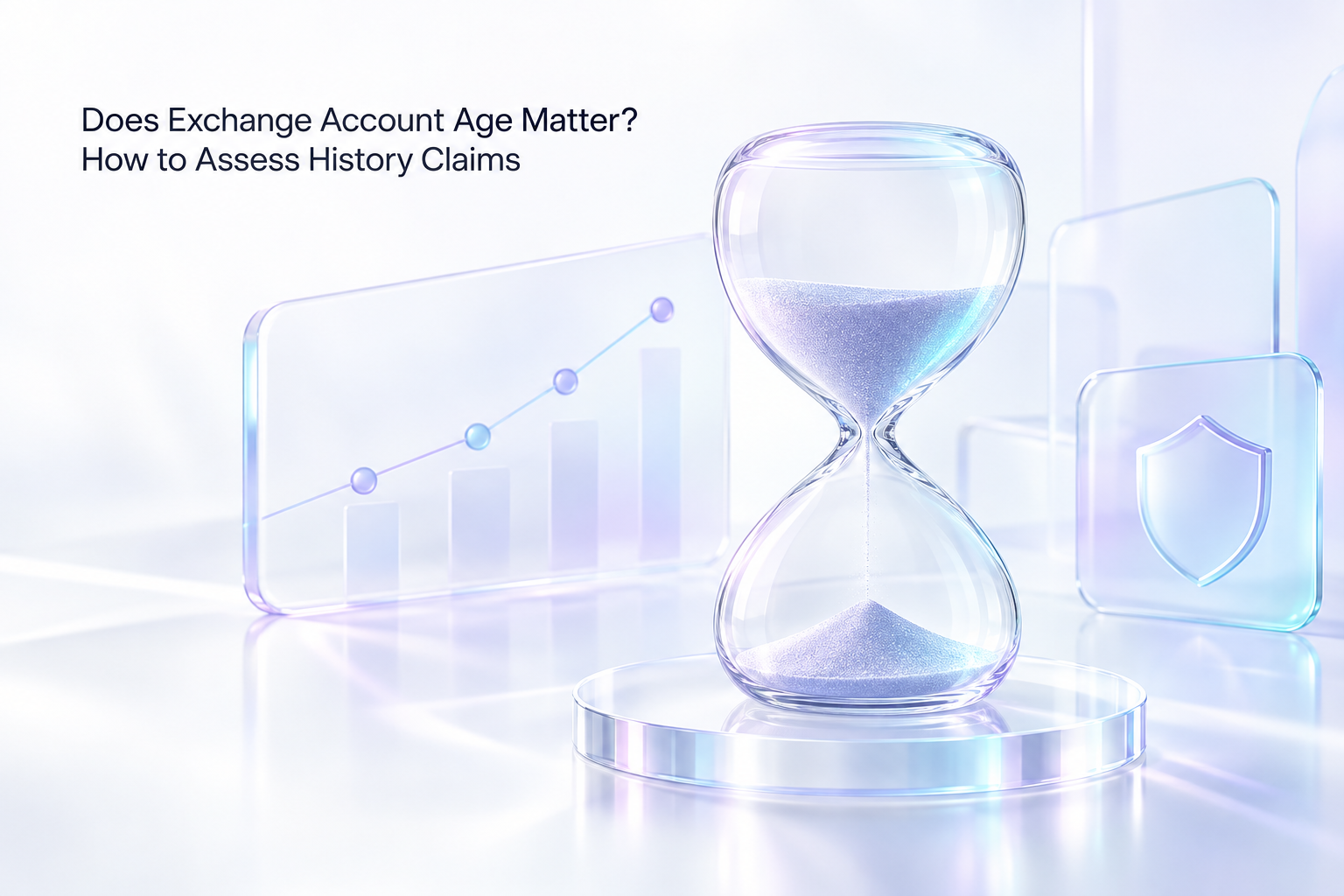
An exchange account's age can sound like a simple quality signal: an older account must be more established, more reliable, or more trusted. In practice, a registration date answers only one question—when the account was created. It does not establish who may use it today, what permissions it has, or whether its history supports the claims made about it.
For anyone considering Aged Exchange Accounts, the useful question is not simply “How old is it?” It is “What does the available evidence establish, and is the proposed arrangement permitted?” This guide explains how to assess tenure and history without confusing marketing language with platform-confirmed facts.
1. Separate Registration Age from Meaningful History
Age measures elapsed time
Registration age is the time since an account was created. If a reliable record shows a creation date from several years ago, that supports a claim about tenure. It does not prove continuous activity during those years.
An account might have remained dormant for most of its existence. Another account with a more recent creation date might have a well-documented operating history. Neither pattern is automatically better; they simply describe different things.
Activity and continuity answer different questions
Activity history concerns what happened during a period. Continuity concerns whether the account's ownership, authorized operators, and purpose remained consistent. These details matter because an old registration date can coexist with long gaps, changes in business control, or outdated account information.
Consider two hypothetical offers. One states “five years old” but provides no information about activity or current status. Another states “two years old” and clearly distinguishes registration evidence, recent status, and platform-approved ownership. The first has greater claimed age; the second has better-defined evidence. Do not mistake those dimensions for the same thing.
2. Define What a Clean-History Claim Covers
“Clean history” is incomplete unless the person making the claim explains its scope. It could refer to no currently visible restrictions, no disclosed unresolved disputes, or a review of records over a defined period. Those are not interchangeable statements.
Ask for a period and a definition
Useful questions include:
- What start and end dates does the review cover?
- Which records were reviewed?
- Does the statement concern current status or the entire account lifetime?
- Were any past restrictions disclosed, including resolved ones?
- Who performed the review, and what could they actually verify?
A statement that there are no visible restrictions today is narrower than a claim that no restriction has ever occurred. Narrow, well-supported claims are more useful than sweeping assurances without evidence.
Recognize the limits of negative evidence
The absence of a warning in a screenshot does not prove the absence of historical problems. A selected screen may omit relevant records, and some platform decisions are not fully visible to customers.
That does not mean every history claim is false. It means the conclusion must match the evidence. “No restriction shown on this dated screen” may be supportable. “Guaranteed problem-free forever” is not.
3. Treat Trust Scores as Undefined Until Explained
Trust-related language deserves particular care. A listing may describe an account as having a higher trust score without naming a system, showing a value, or explaining the comparison.
Identify the source of the score
Ask whether the score is an official customer-visible platform metric, a seller's internal assessment, or simply a descriptive phrase. If there is a numerical value, ask what scale it uses, when it was recorded, and whether the exchange documents its meaning.
A seller-created rating should not be presented as an official exchange judgment. Likewise, a general statement about established history should not be treated as proof that the platform gives older accounts privileged treatment.
Do not infer operational privileges
Even a documented metric does not automatically establish higher limits, guaranteed withdrawals, or exemption from monitoring. Those claims need their own evidence and must remain consistent with platform rules.
Avoid any offer that presents age or trust as a way to skip identity checks, conceal the actual operator, or avoid compliance review. Historical verification is not a transferable credential that makes a different person eligible to trade.
4. Check Permission Before Spending Time on Valuation
A detailed history review has little value if the proposed access arrangement is prohibited. Establish permission before comparing premiums, negotiating a price, or examining sensitive records.
Distinguish technical access from authorization
Being able to sign in does not prove a right to operate an account. Possession of a password, access to an inbox, or a seller's willingness to hand over credentials cannot override exchange terms.
Many exchanges restrict account transfers or require accounts to remain associated with the verified holder. Where business ownership changes or delegated access are supported, the platform may require a formal review. Do not assume that a procedure available for one account type applies to another.
Use official clarification
Review the relevant terms and, if necessary, contact the exchange through its official support channels. Describe the intended arrangement accurately rather than asking only whether an account can remain active.
If the platform does not permit the arrangement, stop there. Opening your own eligible account or using an officially supported organizational structure is preferable to paying for access you cannot legitimately use.
5. Build a Privacy-Safe Evidence Record
The goal of due diligence is to reduce uncertainty, not to collect another person's private information. Ask for the minimum information needed to assess each claim.
Match each claim to a record
A compact review table can help:
| Claim | Relevant evidence | Important limitation | | --- | --- | --- | | Established age | Dated registration information from an official source | Does not prove continuous activity | | Current verified status | Current platform status, shared appropriately | Does not establish a new user's eligibility | | Clean history | Defined review scope and relevant redacted records | Cannot establish undisclosed lifetime events | | Permitted ownership change | Applicable terms and official confirmation | Approval may be conditional | | Higher trust score | Named metric, source, date, and explanation | Does not automatically establish privileges |
Record whether each point is seller-stated, supported by a document, or confirmed through an official channel. These levels of confidence should not be collapsed into a single “verified” label.
Protect sensitive information
Do not request passwords, recovery codes, identity-document copies, or unrestricted access to financial records as proof. Documents should be appropriately redacted. Screenshots can be incomplete or altered, so they should not be treated as conclusive simply because they look professional.
Never upload private account records to an unknown verification website. If you cannot validate a material claim safely, mark it as unresolved rather than expanding the amount of sensitive data exchanged.
6. Evaluate an Age Premium Without Guessing Its Value
There is no universal formula that makes an older exchange account worth a particular amount. Value depends on permitted use and documented characteristics—not just elapsed years.
Separate facts, relevance, and price
Use three questions for each claimed advantage:
- Is it established? Identify the evidence and its limitations.
- Is it relevant? Explain how it serves a legitimate requirement.
- Is it worth paying for? Compare the offer with an eligible account opened directly through the platform.
For example, a well-supported creation date may still have little practical value if the exchange does not connect tenure with any capability you need. Conversely, historical continuity might matter in an authorized business review, but that does not justify assumptions about personal account transfers.
Keep unknowns visible
Write down the one-time price separately from exchange fees and any other confirmed costs. Record unanswered questions about availability, included access, and commercial terms. Do not fill those gaps with assumptions from another listing.
When reviewing the store's Aged Exchange Accounts listing, request account-specific clarification through Telegram or WhatsApp. Use store support for offer details, but rely on the exchange itself for the meaning of platform policies and permissions.
7. Know When to Pause or Walk Away
Some gaps call for clarification. Others undermine the arrangement entirely. An unspecified registration date can be clarified; a request to impersonate the verified holder should end the discussion.
Pause or decline when an offer involves:
- Claims that age removes identity or compliance requirements.
- Guaranteed immunity from restrictions or future reviews.
- Refusal to define what “clean history” means.
- Pressure to pay before permitted access is established.
- Requests to retain another person's identity or recovery methods.
- Conflicting records with no credible explanation.
- Promises of platform privileges unsupported by official information.
Keep a brief decision record stating which claims were established, which remain uncertain, and why you proceeded or declined. This makes your comparison repeatable and prevents sales language from becoming an assumed fact later.
Conclusion
Exchange account age is a narrow historical fact, not a blanket measure of quality. Assess registration tenure, activity, current status, and platform permission separately. Require clean-history and trust claims to have clear definitions, dated evidence, and realistic limits.
Most importantly, establish that your intended access is authorized before considering price. A sound decision rests on lawful eligibility and supported facts—not on the assumption that an older account must be safer, less restricted, or more valuable.

Mentioned in this article
Aged Exchange Accounts
Long-standing verified exchange accounts. Confirm account age, history, permitted access, and current availability before ordering.
$149.00
View product