Why Gateway Sales Don't Equal Available Payouts
Understand pending balances, settlement delays, reserves, refunds, and payout deductions so your business can plan around money it can actually use.
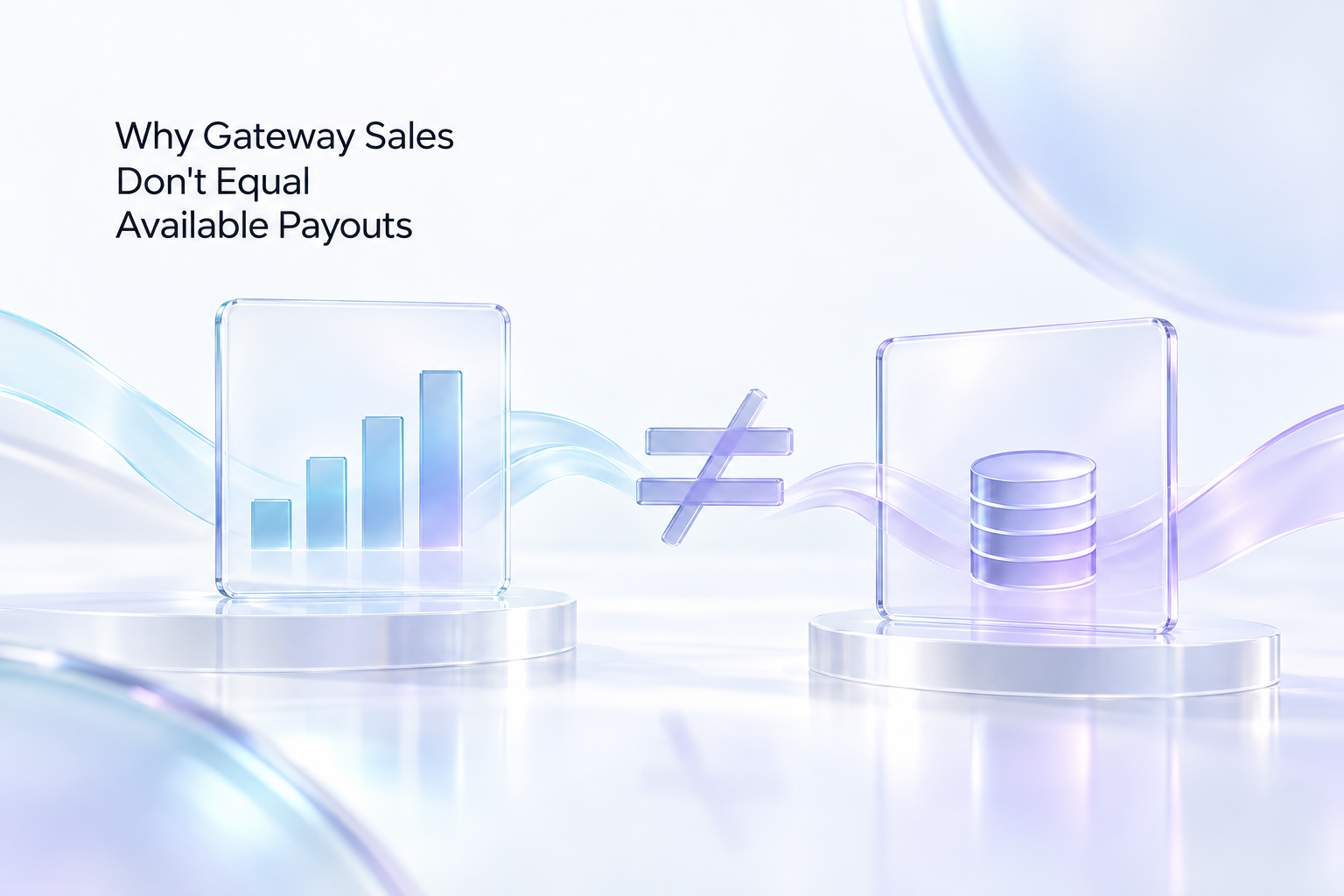
A busy checkout can make a business look cash-rich while its bank balance tells a different story. Customers have paid, orders are moving, and the gateway dashboard shows growing sales—but only part of that money may be available for payout.
For businesses processing many transactions, understanding this gap is essential. Payment acceptance, settlement, payout eligibility, and bank receipt are different events. Confusing them can lead to premature supplier payments, overstated available cash, and unnecessary concern about ordinary processing delays.
This guide explains how money moves through a payment gateway, why balances differ, and what to check before relying on a payout. The examples are illustrative, not terms promised by any account or provider.
1. Understand the Stages Between a Sale and Spendable Cash
Authorization is not settlement
For a typical card payment, authorization means the issuer has approved the transaction at that moment. It does not necessarily mean the merchant has captured the payment or that the proceeds are ready to withdraw.
Some payment flows capture automatically; others capture later. An authorization can expire or be reversed without becoming a completed sale. Payment methods differ, so always consult the provider's definitions rather than treating every successful-looking status as cash received.
Capture and settlement are separate milestones
Capture generally moves an authorized card payment toward financial completion. Settlement refers to the movement and accounting of funds through the relevant payment system. A gateway may show captured proceeds as pending while settlement or its availability period continues.
The practical lesson is simple: a completed customer checkout is not a reliable signal that the proceeds can fund an outgoing business payment today.
A payout still has to reach your bank
Once funds become eligible, the provider may include them in a scheduled payout. That payout then travels to the receiving bank or other approved destination.
A status such as “sent” can mean the provider has initiated the transfer, not that your bank has credited it. Bank processing schedules, destination details, and local holidays can affect arrival.
2. Read Each Balance According to Its Definition
Gross sales show activity, not liquidity
Gross sales usually describe payment activity before some or all deductions. Depending on the report, the figure may include transactions that have not settled or may exclude particular payment states.
Always check the reporting definition and date basis. A report organized by transaction date can legitimately differ from one organized by settlement date, even when both are correct.
Pending funds are not yet available
Pending balances may represent payments awaiting settlement or completion of a provider-defined availability period. They may also contain funds subject to a separate review, depending on how the dashboard is designed.
Do not assume every pending payment will become available on the same day. Payment method, transaction timing, risk review, and account conditions can create different availability dates.
Available balance is still not bank cash
Available balance generally indicates funds eligible for payout under the provider's current rules. Minimum payout thresholds, payout schedules, or account restrictions can still affect when those funds leave.
Use bank-confirmed receipt for spending decisions that require certainty. Treat an expected gateway payout as a forecast until it has arrived and is usable.
3. Identify the Deductions That Reduce a Payout
Processing fees and other charges
Providers may deduct transaction fees before payout, invoice them separately, or use a combination of methods. Cross-border charges, currency conversion, and payout fees may also apply.
Check when each fee is recognized. Otherwise, your team may mistakenly deduct a charge twice when forecasting or overlook one that will be billed later.
Refunds and disputes
Refunds can reduce a current balance even when the original sale occurred in an earlier reporting period. Disputes can also create debits and separate fees under the provider's terms.
This timing mismatch explains why a strong sales day can produce a smaller-than-expected payout. Today's available funds may be covering obligations linked to last month's transactions.
A simple illustrative calculation
Suppose USD 20,000 in captured payments becomes eligible for a payout calculation. Assume the provider deducts USD 600 in processing fees, USD 800 in refunds, USD 300 in dispute-related debits, and USD 1,000 for a reserve.
The resulting amount is USD 17,300, before any additional adjustments or payout charges. Those figures are hypothetical. The important point is the structure: sales minus applicable deductions does not necessarily equal the dashboard's headline sales total.
4. Understand Reserves Without Treating Them as Fees
What a reserve does
A reserve is money withheld under the provider's agreement to cover potential obligations, such as refunds or disputes. It affects liquidity even when it is not recorded as a processing fee.
Reserve arrangements vary. A provider may retain a percentage of transactions for a defined period, hold a fixed amount, or apply another contractual structure. Do not assume that a reserve exists—or that none applies—without checking the account terms.
Release conditions matter as much as the percentage
A quoted reserve percentage tells only part of the story. Ask how long funds are held, when release begins, whether release is automatic, and what circumstances can delay it.
A rolling arrangement may release older retained amounts while withholding a portion of new activity. That can make the reserve balance appear stable even though individual amounts are moving through it.
Forecast releases conservatively
Do not count the entire reserve balance as next week's cash. Use documented release dates and account for any conditions attached to them.
If release timing is uncertain, show it separately from confirmed incoming payouts. This keeps uncertain funds from silently supporting commitments that require definite payment dates.
5. Build a Payout Calendar That Reflects Real Timing
Distinguish business days from calendar days
A stated delay measured in business days can stretch across weekends and holidays. Provider cutoff times and time zones also matter: two payments made minutes apart can fall into different processing batches.
Ask which event starts the timing clock. It might be capture, settlement, or another provider-defined milestone. “Two days” is not a useful promise unless its starting point and day-counting method are clear.
Separate the processing delay from payout frequency
Funds might become available daily while payouts occur weekly. Alternatively, payouts might run daily while individual payments take several business days to become eligible.
Record both rules. Your calendar should show expected availability, scheduled dispatch, and estimated bank arrival as separate entries rather than collapsing them into one date.
Stress-test a busy period
Model what happens if sales increase sharply while payouts remain on their normal schedule. Include higher refund demand, a public holiday, and an unexpected review as separate scenarios.
These are planning exercises, not predictions. Their purpose is to reveal whether the business has enough working capital to fulfill orders without depending on the fastest possible payout outcome.
6. Investigate a Smaller or Late Payout Systematically
Start with the matching payout report
Compare the expected payout with its own transaction and adjustment records. Do not compare a Monday bank deposit directly with Monday's sales unless the provider's reporting confirms they cover the same activity.
Useful fields include payout ID, reporting period, gross included payments, fees, refunds, dispute debits, reserve movements, and net transfer amount. Check currency as well as value.
Find the stage where progress stopped
If funds are pending, investigate availability rules or account notices. If funds are available but no payout exists, check the schedule, minimum threshold, and payout configuration. If a payout was sent but has not arrived, check its destination and transfer reference.
This stage-based approach produces a more useful support request than simply saying that money is missing.
Escalate without exposing sensitive information
Use the provider's official support channel for transaction investigations. Supply the payout reference, relevant dates, currency, expected amount, and observed status.
Do not share passwords, authentication codes, or full customer card details. If account documents are requested, use the provider's approved secure submission process. Never attempt to bypass a hold by misrepresenting your business or routing activity through an unauthorized account.
7. Ask Better Questions Before Choosing an Account
When evaluating Business Payment Gateway Accounts, request payout and reserve terms alongside processing capacity. A high-volume description does not establish how quickly proceeds become usable.
Ask for the following details in writing:
- Which payment events determine funds availability?
- What payout schedule, cutoff time, and time zone apply?
- Are there minimum payout amounts or transfer charges?
- How are refunds and disputes funded?
- Can reserves apply, and what governs their release?
- Does your business qualify for the proposed account arrangement?
Digital Accounts Shop can clarify the listed offer and availability through Telegram or WhatsApp. Provider-controlled settlement conditions and permission for your business to use an account should also be checked against the provider's official terms.
Conclusion
Gateway sales measure payment activity; available payouts measure only part of the money moving toward your business. Neither should automatically be treated as cash already in the bank.
Understand the payment stages, identify deductions, document reserve conditions, and build a calendar around actual payout rules. When a number looks wrong, trace it through the relevant payout report before drawing conclusions. This gives high-volume businesses a more dependable basis for fulfillment, supplier payments, and day-to-day spending.
Mentioned in this article
Business Payment Gateway Accounts
Verified gateway accounts built for high-volume business transactions. Confirm eligibility, included access, and availability before ordering.
$249.00
View product